I grew up learning how to survive before learning how to live.
As the civil war broke out in Somalia, we fled as a family and took refuge in our neighboring country, Kenya. Like many Somali refugees, we stayed in Kakuma Refugee Camp. I do not remember much about the camp or what life was like there, as I was very young at the time.
I think the trauma of fleeing a civil war, becoming refugees in an unknown country, and living in a refugee camp with my family was too much for my little brain to handle. I believe I blocked most of it out. Because of that, I have almost no memories from our time there.
The only thing I remember vividly is the birth of our brother and how happy we were in that moment. That memory stayed with me. It was also the last time we lived as an extended family, with grandmothers, uncles, aunts, cousins, and other relatives all together. After that, everyone went their separate ways. People traveled to different countries and even different continents.
From then on, it was just my mother and us, alone in an unfamiliar country.
After some time, we relocated to Eastleigh, Nairobi. It was my mother and my siblings, nine of us in total. Our youngest had not been born yet. We lived in a one bedroom apartment with a bathroom outside. It was a shared bathroom used by everyone in the building.
Life was tight and uncomfortable, but it was what we had.
Over time, our family grew smaller. My eldest sister traveled to Saudi Arabia to live with my aunts. My eldest brother went to Mombasa looking for work and stayed with his father’s side of the family. Another sister, older than me, traveled to Europe with one of my aunts.
Eventually, it was just my mother and six of us left in Eastleigh.
After leaving the refugee camp and losing the support of our extended family, the full responsibility of providing for us fell entirely on my mother. She became the sole breadwinner for six children in a foreign country, as a refugee, without speaking the local language.
Out of necessity, she started selling vegetables and fruits on the streets. Later, she transitioned into selling clothes, and eventually into selling gold. She continued selling gold until we relocated to the United States.
My mother became a businesswoman not by choice, but out of survival. Over time, that became her entire life, the only thing she knew and the thing she was best at. The difficult circumstances of life forced her into constant survival mode. She had to step fully into masculinity and abandon femininity just to keep herself and her children alive.
Because of that, my mother never really had the chance to just be a mother to her children. To this day, she still struggles with this. She never stopped being a businesswoman, because that role became her identity.
When my older siblings left, our third eldest sister, who was the oldest among us at the time, became the mother of the house.
And being a mother means sacrifice.
For her, that meant her childhood ended early. She cooked, cleaned, and took care of us. She never attended school or dugsi because of the responsibilities she was forced to carry.
Looking back, I am grateful I was not the eldest. I do not think I could have carried that kind of responsibility at that age, or at any age.
For a long time in Eastleigh, we lived in survival mode. We were not really living. We were just trying to get through each day.
Affording basic necessities became the only priority. Shelter, food, and healthcare came first. Everything else was secondary. School and dugsi did not happen at first. Survival was the goal, and even as children, we understood that. We did not think beyond it.
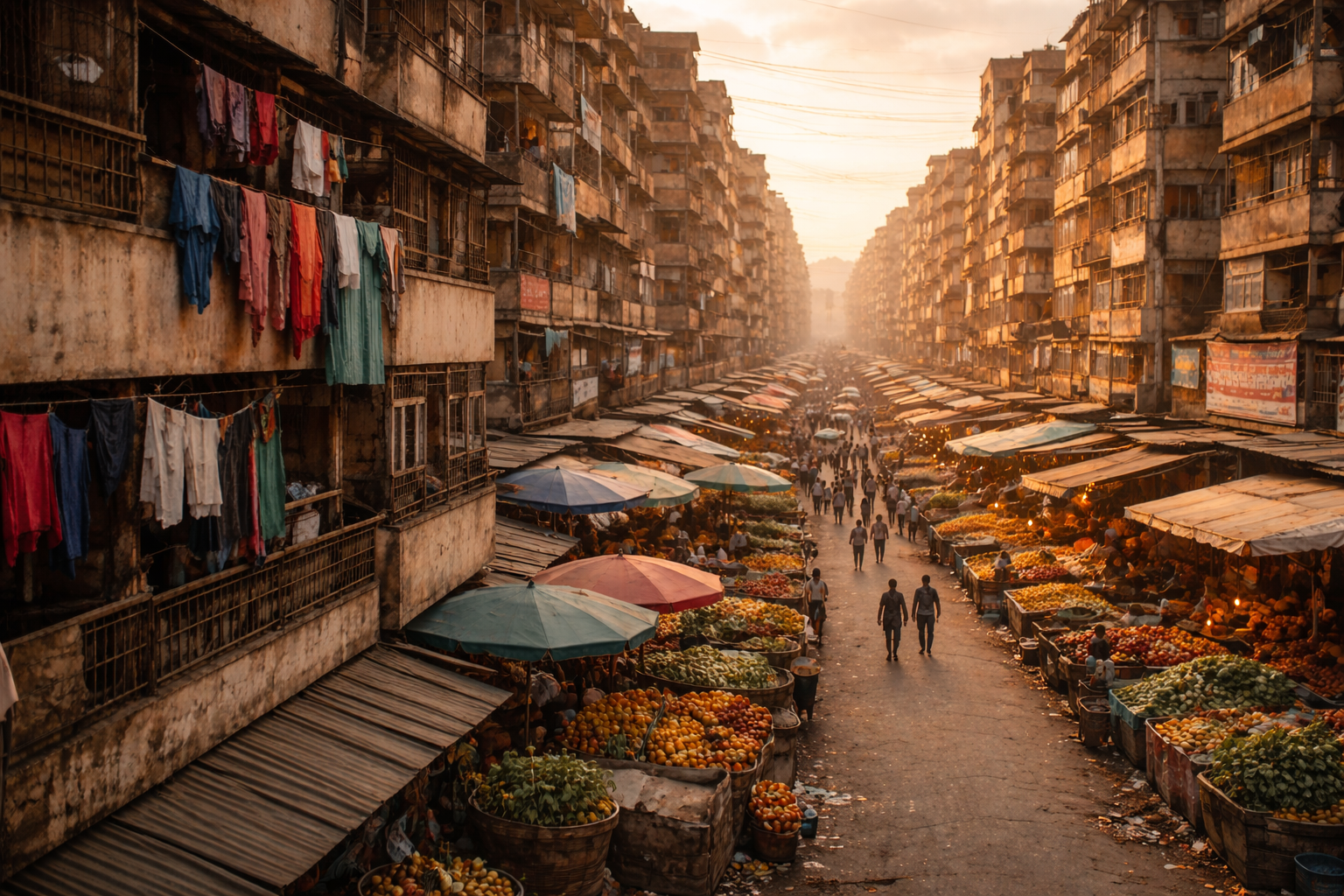
We lived in a difficult neighborhood. There were many chokoraa, homeless children living on the streets. Getting water was a constant struggle. The smell of trash piled nearby became part of our everyday life. Illness and malnutrition were common.
That was our reality for a long time.
After a few years of living purely in survival mode, our lives slowly became more stable. My mother’s business began to support us more consistently, and we grew more familiar with life in Eastleigh. Except for my older sister, we all started going to school and dugsi once my mom was able to afford it.
We began speaking the language, making friends, and finding some sense of routine. Eventually, we moved into a two bedroom apartment where the kitchen and bathroom were inside and belonged only to us. For me, not having to share a bathroom with other people felt like the clearest sign that life was getting better.
It felt like proof that we were no longer just surviving.
For the first time, I believed that things could only go up from there.
Kenya also began to feel like home. At the same time, Somalia, our home country, started to feel like a distant memory, something we carried with us rather than a place we could return to.